

The Swing Index indicator determines the real price of the asset by comparing the current and the previous prices high, low, open, and close.
Developed by Welles Wilder, the Swing Index is used as a part of the Accumulative Swing Index, with the indicator mentioning the swing index of each bar. It suggests a value between 0 and 100 for an up bar and 0 and -100 for a down bar.
Your capital is at risk
 Accuracy
 Profitability
 Maximum Drawdown
 Average Drawdown
 Drawdown Duration
Annualized Return
Drawdown Duration
Annualized Return
 Sharpe Ratio
 Profit Factor
 Win Rate
The indicator doesn’t come with any settings. As for the timeframe, you should use the Swing Index indicator on higher timeframes to reduce market signals.
Swing Index Indicator settings
The Swing Index indicator can help you determine the trend’s direction through crossovers.
When the Swing Index crosses above zero, it signals an uptrend. Here, you can take buy positions. Conversely, when the SI crosses below zero, it’s a sign of a downtrend, and you can take sell positions.
Swing Index Indicator trade setup
The second way to trade with the Swing Index is by finding divergences. The price makes higher highs in the bearish divergences, but the indicator makes lower highs. It means a weakening of bullish momentum, and there is a possibility of a trend reversal.
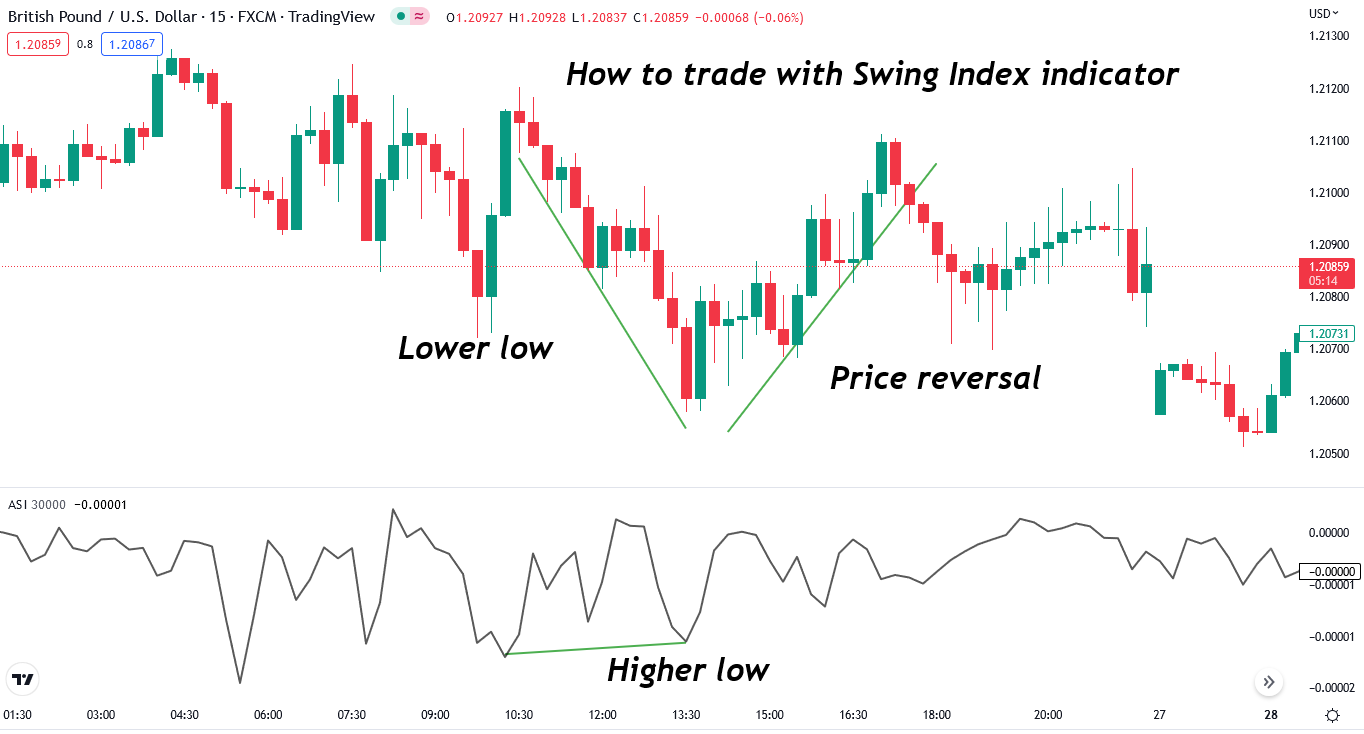
Conversely, the price makes lower lows in bullish divergences, and the Swing Index makes higher lows. It mentions a weakening bearish momentum and a chance of trend reversal.
The chart below shows that when the price made a lower low, and the Swing Index made a higher low, the price reversed.
Swing Index Indicator trade setup
The Swing Index can also help in determining short-term breakouts. An upward breakout occurs when the SI exceeds its value from the previous highest point. On the other hand, a downward breakout appears when the SI falls below the previous lowest point.
If you want to confirm the breakouts, you can do that by comparing the trendlines on the SI to the trendlines on the chart. As you can see on the chart below, we have similar trendlines on the chart and the Swing Index.
When the trendline on the chart doesn’t match the trendline on the Swing Index, we have a false breakout.
Yes, you can use on any timeframe.
The same way you test on MT4. Just use the MT5 compatible indicator file on the chart.