

Investors often face a tough decision between the traditional Forex market and the growing digital currency market in today's financial landscape. This article delves into a logical comparison of crypto and forex markets and provides food for thought so you can better decide for yourself.
.png)
Is Forex trading better than crypto? Are you looking for a guide to choose between the two?
In the current landscape of thriving financial markets, many investors find it challenging to choose between the traditional Forex market and the burgeoning digital currency market.
The quest for higher profits and faster returns prompts the crucial question: which market holds the key to superior financial gains?
This article aims to unravel the intricacies of this choice in the piece titled "Forex or Digital Currency: Which is Better?"
Before delving into the central theme, let's briefly explore the historical evolution of the Forex and digital currency markets.
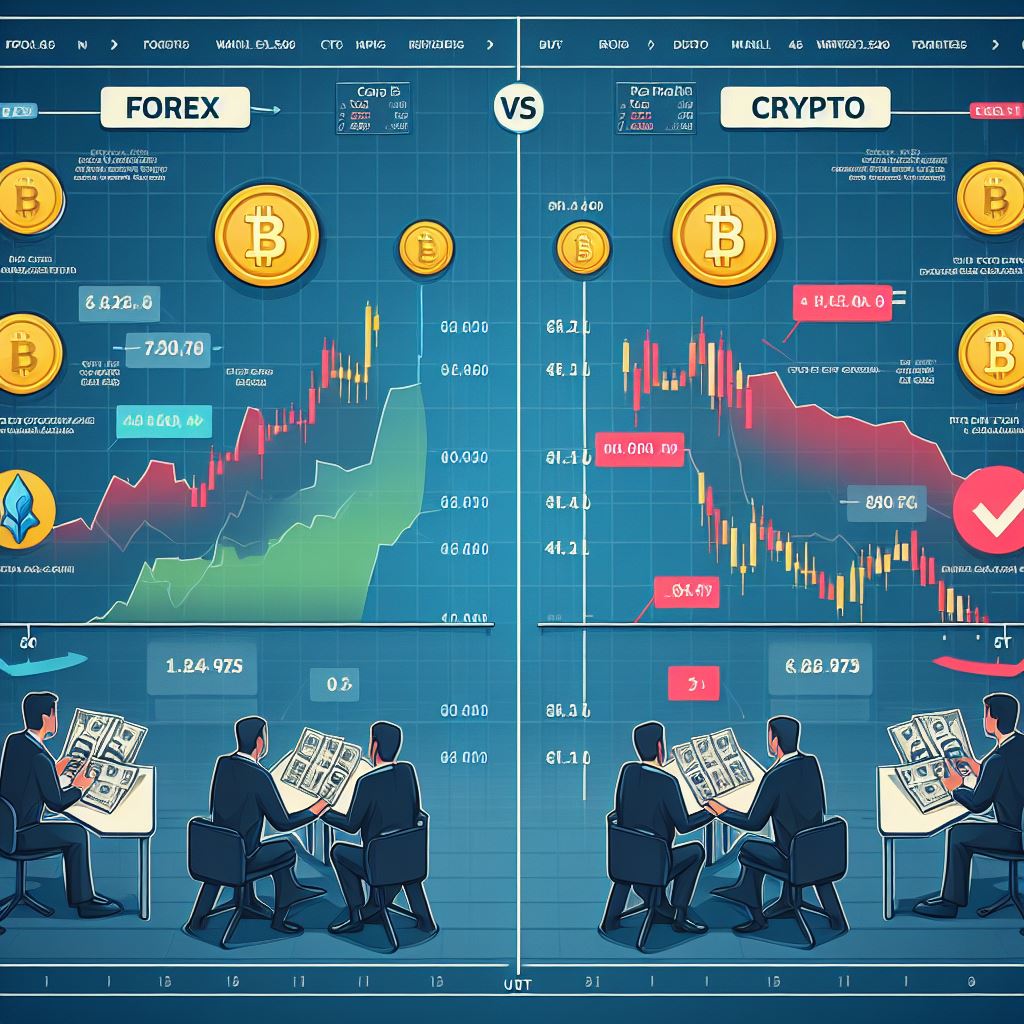
The roots of the Forex market trace back to 1971, gaining momentum since 1998 with technological advancements.
Encompassing the exchange of currencies from different nations, Forex boasts over 170 currency pairs today.
While major players include financial institutions and banks, a small fraction, around 5%, are individual traders engaging in currency transactions.
In contrast, the digital currency market, initiated in 2009 with the advent of Bitcoin, has a relatively shorter history.
The emergence of various cryptocurrencies, such as Ethereum and Ripple, has fueled its growth.
Digital currencies, appreciated for their decentralized nature, have garnered widespread acceptance, with enthusiasts considering them the future of money.
The Forex market is the world's largest financial market, boasting a daily trading volume exceeding $6 trillion.
Meanwhile, while growing, the digital currency market experiences increased transaction volumes with the rising adoption of various cryptocurrencies.
Forex operates 24 hours a day, five days a week, whereas the digital currency market remains active around the clock, seven days a week, 365 days a year.
Forex is influenced by central bank policies, economic conditions, and political news, while the digital currency market is shaped by technology, innovation, regulatory developments, and investor demand.
Digital currency markets tend to exhibit higher price volatility than Forex, offering greater profit potential and increased risk. Forex, on the other hand, is relatively more stable and has the potential for high returns.
Forex predominantly involves currency pairs, while the digital currency market encompasses various cryptocurrencies like Bitcoin, Ethereum, and Ripple.
The choice between the Forex market and digital currency hinges on individual goals, risk tolerance, and knowledge. Several factors influence this decision:
With their high price volatility, cryptocurrencies attract risk-tolerant investors seeking substantial returns.
Being more stable, Forex may be suitable for those prioritizing stability over high profits.
For those seeking extended trading hours, the digital currency market's 24/7 availability may be preferable, while Forex operates within specified business days and hours.
Forex, being a more established market, is often more familiar to investors compared to the growing digital currency market.
Investors should consider whether they are more comfortable navigating the global economic landscape (Forex) or the dynamic factors shaping the digital currency market.
Ultimately, the decision between the Forex market and digital currency is subjective and depends on individual preferences, risk tolerance, investment goals, and market understanding.
Success in either market requires adequate knowledge, skills, and experience. Acknowledging the inherent volatility and risk in financial markets is crucial, regardless of the choice.
Your level of interest in and commitment to your chosen market will play a pivotal role in achieving success.